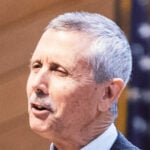

This address was delivered on Oct. 9, 2024, at Theology Matters’ fourth conference at Providence Presbyterian Church, Hilton Head Island, South Carolina
As I end my seventh decade of life, I find myself taking stock again of who I am. As with any life, there have been high points and low ones, moments of success and of failure. I have long outlived my father, who died of a sudden heart attack at age forty-eight, when I was nineteen years old. I was blessed with a mother who lived to be ninety-three and was lovingly devoted to her children and grandchildren. I don’t always understand why I am wired the way I am; I sometimes wonder how my life would have been different if I had been six foot one instead of five foot six. My wife has been my loyal friend and partner, and we have three daughters, each with her particular gifts and struggles.
Who am I? It was a question that gnawed at the German theologian Dietrich Bonhoeffer, as he sat in a Nazi prison. In his letters and papers that were smuggled to the outside, he struggles to understand what God is doing, where God is in the midst of Hitler’s mad war, Nazi eradication of the Jews, and a docile, disoriented church. In a poem not long before the Nazis hanged him, Bonhoeffer wrote of how others saw him as brave and confident, although he inside felt “restless and longing and sick, like a bird in a cage, struggling for breath.” “Who am I?” he asks, “This or the other? Am I one person today, and tomorrow another? They mock me, these lonely questions of mine.” And then, after all that self-searching, Bonhoeffer nevertheless declares, “Whoever I am, thou knowest, O God, I am thine.”
Who am I? Who are we, Presbyterians—and, specifically, members of the PCUSA—at the beginning of the twenty-first century? Are we a self-confident denomination committed to social justice and making the world a better place? Or are we deeply anxious inside, because our membership numbers have declined 57 years in a row, from 4.2 million in 1967 to barely 1.1 million today, as though we are in free fall? We can point to vital congregations proclaiming God’s good news and caring for the poor and oppressed, but in my part of the country two-thirds of the churches can no longer afford an installed minister. Who are we, really? The one, or the other? Today, these lonely questions mock us who are Presbyterian.
The theme of our conference is, “The Gates of Hell Shall Not Prevail against It: Standing on Christ’s Promises to His Church.” Like Bonhoeffer, we Presbyterians know that whatever our doubts and fears about the Presbyterian Church (USA), we belong to God. The human institution that is the PCUSA may someday pass away, but God will never allow the church of Jesus Christ to die. But in the time that we still have as Presbyterians, of whatever stripe—PCUSA, ECO, EPC, PCA, OPC—God has laid a special responsibility on us. God, I believe, has given us Presbyterians certain gifts on behalf of the church universal. It is time for us to take stock of what God has given us and of who we are, in order to pass on to the next generation whatever has been good and pure and excellent about our church.
Let me begin, however, in a different place. Over the past decade, I have been studying a Russian religious philosopher by the name of Pavel Florensky. Florensky lived and worked during an extraordinarily creative historical period known as the Russian Silver Age.[1]
Pavel Florensky
Born in 1882 in what is now Azerbaijan, he went as a young man to Moscow to study at the country’s premier university. He could have had a brilliant career as a mathematician. But God, as they say, had other plans. Sometime in his early 20s, Florensky underwent a religious conversion. He abandoned mathematics and became an Orthodox priest and professor. His treatises on Orthodox worship, iconography, and doctrine would be groundbreaking. But in 1933, Stalin’s secret police arrested him and falsely accused him of counter-revolutionary activity. He was sentenced to ten years in the gulag, first in Russia’s Far East and then on a lonely island in Russia’s White Sea, fewer than sixty miles from the Arctic Circle. In 1937, at age fifty-one, he was taken back to the Russian mainland, where he was shot. The pit into which his body was dumped has never been found.
Soon after his conversion to Christianity, Florensky married Anna Giatsintova. The couple lived in the small town of Sergiev Posad, where Russia’s greatest monastery is located. Florensky taught at its theological academy. They would have five children—three boys (Vasilii, Kirill, and Mikhail), and two girls (Olga and Maria). Living conditions were difficult. Food was scarce, the Bolsheviks closed the theological academy where Florensky taught, and persecution of the church accelerated. Although often away from home, Florensky was a devoted father. He loved to take the children on walks into the surrounding countryside, and he encouraged each child’s intellectual creativity and growth. Indeed, each turned out to have remarkable talent. In adulthood, Vasilii became a geologist; Kirill, a planetary scientist; Olga, a botanist; Maria, a chemist; and Mikhail, a specialist in drilling oil wells.
After his arrest and imprisonment, Florensky was able to have only one visit from Anna and the three younger children. But the family was allowed to correspond. Florensky could write one letter per month; Anna could write more often and occasionally could send a small care package. After the fall of communism and the Soviet Union in 1991, the letters were collected and published under the title, All My Thoughts Are about You. Although Florensky had to be cautious about what he wrote––all the letters went through a censor, and he did not want to endanger the family by describing the dire conditions in the camp––he did not hesitate to offer practical life advice to Anna and each child. As for Bonhoeffer, prison became for Florensky an opportunity to think about who he was and what he wanted to pass on to others while he still had time.
Three Themes Dominate
Three themes dominate in Florensky’s correspondence: He wants each member of the family to know the family’s unique heritage; to become familiar with humanity’s great cultural achievements; and to spend as much time as possible in the natural world. Florensky himself had been profoundly shaped by these three factors. In researching his ancestry, he learned that he had roots not only in Russia, but also in Asia Minor and perhaps even in North Africa. Each tie to the past, he believed, had shaped his personality. The fact that a great-grandfather had been a priest was for him another important part of the family legacy, as were his father’s and grandfather’s scientific interests.
As for great culture, Florensky had grown up hearing his mother play Mozart and Beethoven on the family piano. Later, he came to love Bach’s music. He writes about delighting in the very sound of beautiful poetry, such as that of Russia’s great Alexander Pushkin. After Florensky’s conversion, Russia’s great Orthodox heritage––its ancient cathedrals and historic icons––deeply touched him, and he worked to preserve them from Bolshevik desecration, seeing them as national treasures. But he also wanted to learn about other cultures, especially those of ancient Egypt and Greece and of Russia’s indigenous tribal peoples.
Equally important to Florensky was his encounter with the wonders of creation. As a child, he had accompanied his father on expeditions into the wilds of the Caucasus. In his memoirs, he writes about his amazement at nature’s surprising phenomena: “An attraction to the mysterious lived within me. … The mysterious concentrated itself in mushrooms, ferns, lichens, mosses, algae––in general, in all those created things that lie close to the boundary of life, to the boundary between the animal and the plant kingdoms.” Later in life, Florensky regularly sought solace in the natural world. Even in his letters from the gulag, he takes time to describe the remarkable colors of the northern lights or the play of the sun’s rays on the grey sea. He especially loved looking into the deep blue color of a clear sky.
Now, in prison, thousands of miles from his family, Florensky longs to pass on his life experience to his children. In his letters, he expresses regret that he had not given them the time they deserved when he was still with them. He promises that if he ever gets out of prison, he will devote himself entirely to them. He wants each child to have a good, fulfilling life. As he writes in a letter to his son Vasilii, “I want you to have as much joy as one can on earth.” Florensky uses his correspondence to encourage each child to be guided by the three factors that had come to mean so much to him: family heritage, great works of human culture, and wonder in creation.
Florensky was convinced that God entrusts each family with a unique calling. In a Testament that he left for his children prior to his arrest, Florensky directed them to collect all that they could of family “portraits, autographs, letters, manuscripts and published essays.” In learning about those who have gone before us, we learn who we are. Florensky believed that his own family’s calling was to spiritual, intellectual work. He hoped that each generation would include a son who would serve as a priest, a calling that both his grandfather and his father had rejected, but that Florensky had accepted. Other family members would honor the family’s calling by entering professions, as did each of his children, in which they could think freely about God and his world. “Thinking,” he wrote, “is God’s gift and requires you to get out of yourself. … Thinking is the guarantor of spiritual freedom.” In this way, Florensky hoped that his children would not submit to communist ideology, although he did not say so directly.
In his Testament to his children, Florensky had written, “The most important thing, what I am asking of you is, above all, that you commemorate the Lord and walk before him. … Everything else … is secondary. Never forget this.” He asks that on the day of his death, the children receive the Eucharist––and that they receive it as often as possible afterwards. Later, from the gulag, Florensky is unable to speak directly about religious faith—because of the prison censor, he would have had to write the word “God” with a small g, which for him would have been an act of desecration. But he does not give up; he develops a kind of code by which to speak to the family about ultimate, spiritual matters.
When Florensky writes, “All my thoughts are about you,” a phrase that repeats itself throughout the correspondence, he is assuring the family that he is praying for them. When he asks his children to look at the “whole” of things, he is alluding to the God who unites all of reality. Another religious allusion occurs in a letter to his daughter Olga, where Florensky writes, “What I want above all is that you cultivate in yourself a vital attitude toward life, and that you be able to perceive reality symbolically.” Avoiding religious language that a prison censor might strike out, Florensky explains that a symbol reveals what is “higher” in what is “here and now.” He refers to the eighteenth-century German poet Goethe, hoping that Olga will remember that, for Goethe, every created thing, if we have eyes to see, opens us to, and participates in, the divine. In another letter, he asks Olga to “think clearly,” an allusion again to the family’s calling to spiritual-intellectual work.
Florensky’s prison correspondence regularly lifts up the second foundation that for him anchors a good, joyful life; an appreciation of what is best––most true, most beautiful—in human culture. Because his family’s calling is spiritual and intellectual, he wants each of his children to play an instrument, learn a foreign language, and become familiar with great literature and poetry. He recommends, in particular, works that elevate rather than trouble the human spirit—and, therefore, he prefers Bach and Mozart to the more emotional and sometimes darker moods of Beethoven or Tchaikovsky. Mathematics and physics, he continues, help train the mind to think clearly. Reading history broadens our appreciation of the great achievements of cultures other than our own.
When Florensky senses that his wife has become spiritually and physically exhausted in caring for the family without his help—finding food during a time of famine, providing for their education, and helping them through adolescent struggles—he offers words that were surely meant for them as well: “It is possible and necessary to fight off [this exhaustion]. Be sure to read something good, listen to music, look at paintings and drawings. Fill your life with those things that are most worthwhile.” Or, as he writes Olga, “Learn to acquire the best of what humanity has brought forth.”
The third foundation for life––taking wonder in God’s creation––is equally prominent in Florensky’s correspondence. “Use the spring and the summer,” he tells Anna, “to see more of the forest, meadows, flowers, clouds. All this is the best that life has to offer, and it calms a person more than anything else does. And for the little one too [his son Mikhail] … nature is the best education.” When Florensky’s son Vasilii and his wife Natalia have their first child, Florensky writes that he would like the boy to spend the entire summer in Sergiev Posad, the family hometown. There, he will “be closer to nature.” Because, in Florensky’s thinking, a baby’s first perceptions of the world shape its personality, he hopes that Vasilii and Natalia will take their son outdoors as much as possible. Encountering flowers, plants, water, sky, clouds, and the dawn will cultivate in him a sense of wonder, even at an early age.
In his Testament to his children, Florensky had advised, “When you feel down, look at the stars or at the azure of the afternoon [sky]. When you are sad, when others offend you, when things do not go your way, when spiritual turmoil comes over you, go out into the air and stand alone with the sky. Then your soul will calm itself.” The symbolic way of thinking that he asked Olga to develop would help each child to see the natural world as a window into God’s glory. In one letter home, Florensky sent drawings of different kinds of seaweed he had been studying near the prison camp. His grandson would later write that these sketches, some executed in striking watercolors, are “an invitation to take delight in the mystery of the created world. … [They] draw us into unmediated communion with the mystery of Nature. Through the organic forms of our lower, created world streams [divine] Light.”
Faithfulness to his family’s particular calling, appreciation of human culture, and wonder in the creation––Florensky saw it as his responsibility to pass these things on to the next generation. He believes that his children, perhaps all children, need these foundations in order to know God, to serve others, and to live well. Florensky challenges me to ask, Have I passed on these foundations to my children? I am no longer young, and they now live in different parts of the country. Is there anything I can still do to point them to God, to help them cultivate a vital faith in Jesus Christ?
But now let me shift the question. What about those of us gathered here at this conference? What about us Presbyterians as a church? What are we responsible to pass on to the next generation? What do we wish to leave as our legacy? What are the foundations that have sustained us and that we hope will sustain our church into the future? Is there any good that we can still do, as membership numbers plummet and disagreements tear our church apart? The gates of hell will not prevail against God’s church, and surely God wishes to use us, weak and imperfect as we are, to help defend it.
Perhaps Florensky can be our guide. Yes, he was Russian, we are American. He was Orthodox, we are Reformed. He lived a century ago, our time and place are completely different. He died for his faith, we still enjoy many freedoms. But like Florensky, we have something valuable—indeed, invaluable––to care for. God has graced us with certain insights, traditions, and forms of life together for the sake of the gospel, and he asks us to be good stewards of what he has given us, perhaps especially in this time in which the Presbyterian Church seems so weak and irrelevant.
A Unique Calling of Presbyterians
Florensky spoke of his family’s unique calling. I would like to ask about the unique calling of the Presbyterian Church. Florensky identified great achievements of human culture that he wanted his children to know. Which Reformed classics of art, music, and literature are we called to guard? Florensky wanted the next generation to experience God’s glory in the creation. Calvin called nature the theatre of God’s glory. Now it is time to ask whether we have been true to our heritage, and how will we pass it on.
Few of us would argue that Presbyterianism is the only way of being Christian. But while we share much with other Christians, we do have a unique identity. What is not always so clear is how to define it. One common response is our representative form of government and the role of ruling elders, whom we ordain. Another approach is found in the PCUSA Form of Government, which lifts up certain theological themes. Here we read that central to our tradition “is the affirmation of the majesty, holiness, and providence of God who creates, sustains, rules, and redeems the world in the freedom of sovereign righteousness and love.” Four other great themes follow: that God elects people to service and salvation, that we live with one another in covenantal fellowship, that we exercise faithful stewardship of God’s creation, and that we work for social justice.
The Reformed theologian Brian Gerrish has argued that Calvin’s theology can be summed up as “grace and gratitude.” Everything begins with God’s unmerited goodness to us—the gift of life, the gift of salvation—and we respond with thankfulness as we worship and serve God. Other scholars have argued that what makes the Reformed tradition distinctive is its doctrine of predestination or its attention to sanctification and the means by which we grow in the Christian life.
Each of these definitions has value. The Reformed tradition has been a rich family conversation with common theological commitments as well as points of debate and even disagreement. Indeed, one of the characteristics of the Reformed tradition has been a reluctance to reduce the faith to a list of doctrines or principles but rather to insist that the church is responsible to discern ever anew what God is asking of us in a particular time and place. The great Swiss Reformed theologian Karl Barth said that the church is, above all, a “listening church.”
Let me propose, then, that our distinctive family calling as Reformed Presbyterians is to listen to God as he speaks a living Word to us in Jesus Christ. God is free to speak a Word that is new to us, that we have not anticipated, that comes to us from outside of us. Yet, we believe that this new Word will be consistent with the one Word that God has already spoken decisively in Jesus Christ. Moreover, we will hear God’s new Word rightly only if we allow Scripture and the church’s great confessions to train our ears. From a Reformed perspective, every church member is responsible to be a Bible-reader, to care about the church’s theology, and to learn from others as they read Scripture and reflect on its witness to Christ. While each person has to listen for him- or herself, God also asks us to listen together in order to hear what God is saying to us together, as the church.
The first thing that we read about God in the book of Genesis is that he speaks. By speaking, he brings a world into being: light and dark, heaven and earth, waters and dry land, sun and moon, plants and animals, and human beings, male and female. The First Letter of John tells us of “that which was from the beginning, which we have heard,” namely, Jesus Christ, who speaks. The last book of the Bible, the Book of Revelation, opens with the living, resurrected Christ saying to John, “I am the Alpha and the Omega.” At the end of the book, Christ declares, “Surely, I am coming soon.” So, a God who keeps speaking to his people and who keeps asking them to listen—that, I believe, is the particular insight that Reformed Christians will share with other Christians and their churches.
Florensky asked his children to learn all that they could about their ancestors. We Presbyterians believe that God asks us to represent to the church universal that Scripture is foundational to all we do. The Bible teaches us not only how Abraham, Moses, and Elijah heard God speaking to them once upon a time long ago, but also how God’s Word to Abraham, Moses, and Elijah is still God’s Word to us in Jesus Christ. God says to Abraham, “Go from your country and your kindred and your father’s house to the land that I will show you”—and Jesus declares, “If anyone would come after me, let him deny himself and take up his cross and follow me.” Christ still calls us to leave the old behind and follow him. Moses asks God his name, and God replies, “I am who I am”—and Jesus says, “Truly, truly, I say to you, before Abraham was, I am.” The “I am who I am” still declares, “Lo, I am with you always, to the close of the age.” God speaks to Elijah in a still small voice––and the resurrected Jesus quietly says to his confused disciples, “Peace be with you.” The peace of Christ, which passes all understanding, still keeps our hearts and our minds in Christ Jesus? Whatever God has promised his people in the past is his promise for us in the present. The God who once spoke is still speaking to his people in and through the Scriptures.
God Asks Us to Offer
Florensky asked his children to become familiar with the greatest achievements of human culture. Similarly, we Presbyterians believe that God asks us to offer the church universal the greatest achievements of our Reformed tradition. I think especially of the confessions of faith that have been so important to Christians in the Reformed tradition. Their words point us to the Word that God still speaks to us in Jesus Christ. Think of the opening lines of the Heidelberg Catechism: “What is your only comfort in life and in death? That I belong––body and soul, in life and in death––not to myself but to my faithful Savior Jesus Christ. … He protects me so well that without the will of my Father in heaven not a hair can fall from my head.” Recall the first question of the Westminster Shorter Catechism: “What is the chief end of man? Man’s chief end is to glorify God, and to enjoy him forever.” Or the first thesis of the Theological Declaration of Barmen: “Jesus Christ, as he is attested for us in Holy Scripture, is the one Word of God which we have to hear and obey in life and in death.” And just as these Reformed confessions have a Word for the church universal, so too they point us to, and build upon, the confessions that we have received from the church universal, especially the Nicene and Apostles’ Creeds.
We could add classic statements of the faith from great Reformed teachers: John Calvin’s Institutes of the Christian Religion, Karl Barth’s Church Dogmatics, or, as a guide to the spiritual life, John Baillie’s A Diary of Private Prayer. We will ask our pastors to learn from these works not only in seminary but also in their years of ministry. We will ensure that church members know something about the ideas and insights of these great Reformed confessions and teachers. God has entrusted us Presbyterians with a precious inheritance. We are responsible to care for it as faithfully as Eastern Ortho-dox believers do for their precious icons, such as Andrei Rublev’s famous Trinity, or as Roman Catholics do for their places of pilgrimage, such as Lourdes, France.
Florensky wanted his children to grow up with a sense of wonder in creation. Our Reformed tradition has sometimes put more emphasis on hearing God’s Word in Scripture than on seeing God’s glory in nature. But we too have a legacy of delight and awe in the natural world, and we will reclaim it. Calvin believed that Scripture itself teaches us to seek God’s truth and goodness in all that God has created. Especially the Psalms, says Calvin, “incite us to praise God, to pray to Him, to meditate on His works to the end that we love Him, fear, honor, and glorify Him.” Think of Psalm 19: “The heavens are telling the glory of God; and the firmament proclaims his handiwork.”[2] Or Psalm 148: “Praise him, sun and moon, praise him all you shining stars. … Praise the Lord … fire and hail, snow and frost, stormy wind fulfilling his command. Mountains and all hills, fruit trees and all cedars. Beasts and all cattle, creeping things and flying birds. … Praise the Lord.” Or Psalm 104: “O Lord, how manifest are thy works. In wisdom hast thou made them all.”
Perhaps no Reformed theologian better captured this sensitivity to nature than the great eighteenth-century New England preacher and philosopher Jonathan Edwards. As a young man, Edwards was fascinated with flying spiders and their “wondrous and curious works.” Observing how they playfully spin their light silvery webs high in the treetops, he concluded, “Hence the exuberant goodness of the Creator, who hath not only provided for all the necessities, but also for the pleasure and recreation of … even the insects.”[3] As one scholar has written, “[For Edwards] all of created reality is permeated with clues to divine truths, if we can but remove the scales from our eyes and see them.”[4] Or we might think of the great American naturalist John Muir, who was raised in a strict Calvinist family. The biblical language that he memorized as a child helped him later speak of America’s natural wonders. At Yosemite Valley, he declared, we are present at “Creation just beginning, the morning stars ‘still singing together and all the children of God shouting for joy.’”[5]
Let us, then, take stock. Inspired by Pavel Florensky’s letters to his children, I have asked: Who are we as Presbyterians at the beginning of the twentieth century, and what has God entrusted to us to hand on to the next generation? I have answered: Our special calling as Reformed Christians is to remind the church universal that God is a living God who is still speaking to his people. He asks us to listen. Moreover, God has entrusted us with three invaluable resources for listening well: the Scriptures, as they set forth God’s living Word in Jesus Christ; the classic statements of the Reformed faith, as they listen to Scripture; and the magnificent beauty of the creation, because it too listens to the Creator and responds to him with praise and thanksgiving.
People sometimes ask me why I am a Presbyterian. I answer: I am a Presbyterian not because I believe in the PCUSA, but rather because I believe that God has given Presbyterians a precious theological legacy. Whatever you feel about General Assembly pronouncements or changes to the Book of Order, I appeal to you to join me. Help me pass on what is best about our tradition to the next generation.
[1] See John P. Burgess, Why Read Pavel Florensky? (Washington, DC: Catholic University of America Press, 2024).
[2] See Calvin’s commentary on Psalm 19: “As soon as we acknowledge God to be the supreme Architect, who has erected the beauteous fabric of the universe, our minds must necessarily be ravished with wonder at his infinite goodness, wisdom, and power.”
[3] “The Spider Letter,” in A Jonathan Edwards Reader, ed. John E. Smith, Harry S. Stout, and Kenneth P. Minkema (New Haven: Yale University Press, 1995), 5.
[4] A Jonathan Edwards Reader, xii.
[5] As quoted in Bruce V. Foltz, The Noetics of Nature: Environmental Philosophy and the Holy Beauty of the Visible (New York: Fordham University Press, 2013).