Remembering the Council at Nicaea
When artists paint on panels and on walls the events of ancient history, they alike delight the eye, and keep bright for many a year the memory of the past. Historians substitute books for panels, bright description for pigments, and thus render the memory of past events both stronger and more permanent, for the painter’s art is ruined by time. For this reason I too shall attempt to record in writing events in ecclesiastical history hereto omitted, deeming it indeed not right to look on without an effort while oblivion robs noble deeds and useful stories of their due frame. For this cause too I have been frequently urged by friends to undertake this work. But when I compare my own powers with the magnitude of the undertaking, I shrink from attempting it. Trusting, however, in the bounty of the Giver of all good, I enter upon a task beyond my own strength.
With these words Theodoret of Cyrrhus (393–457 AD) begins one of the earliest histories of the early church. He wants to paint a picture that will help prevent the deeds of the past from fading from our memory. Like paintings whose colors dim with time he fears the same for our memories of those who had lived and died in the Faith before us. So, too, do we. So, we rely on Theodoret and others of his generation who preserved for us the witness of the faithful. His Ecclesiastical History was among the first and now best preserved. This essay follows his history of the meeting at Nicaea.[1]
Ecclesiastical History
Other histories had been written before his, some already lost; some were being written at the same time as his, Theodoret having stood best the test of modern historical standards, Gibbon characterized the three ecclesiastical writers of the early fifth century as “Socrates, the more curious Sozomen, and the learned Theodoret.” Theodoret writes, he says, at the urging of his friends, acknowledging the “magnitude of the undertaking,” shrinking “from attempting it,” trusting in God, to fill in what had been “hereto omitted.”
Theodoret himself relied on another. He concludes his Prologue: “Eusebius of Palestine has written a history of the church from the time of the holy Apostles to the reign of Constantine, the prince beloved of God. I shall begin my history from the period at which his terminates.”
Eusebius of Caesarea (ca. 265–339, referred to as Eusebius of Palestine here) had been the most famous of historians who had gone before Theodoret. Eusebius’ Ecclesiastical History began where the Biblical author Luke had left off in the 60s AD. It continued in ten books to the events of his day 325 AD––the death of the last persecuting emperor Licinius and elevation of Constantine as sole emperor, the first Christian emperor.
Eusebius and his teacher Pamphilus, a student of Origen’s, had self-consciously continued the legacy of the Alexandrian Origen, who had spent his final days in Caesarea. Together they revived the idea of a world class library as at Alexandria, attempted to rehabilitate Origen’s somewhat controversial reputation and writings, and to re-establish Caesarea as a center of Christian learning, a school of thought, a manner of exegesis, and an important see in the ever-expanding church of their generation. Eusebius’ own reputation depended in large part on his Ecclesiastical History. It was celebrated and trusted. So too today. Even with more exacting standards of scholarship now, most of his sources and almost all of his chronology held up well. His biases are evident; he is a passionate partisan; he has his heroes.
Persecution and martyrdom were common between Luke where Eusebius begins and Licinius where he ends. Eusebius himself had been nearly martyred. His teacher Pamphilus was executed by emperor Diocletian in 310 AD. Eusebius fled to Tyre and then to the Egyptian desert. Arrested, he was imprisoned. Due to the temporary edict of toleration in the East, he was able to return to Caesarea, eventually becoming its bishop, where he died a year after Constantine’s death. During this time of relative peace, he wrote his History.
Theodoret picked up where Eusebius left off––the death of the persecuting Licinius and the beginning of the solo reign of Constatine. The world had changed, he thought, and he wanted to record it. His first chapter begins:
After the overthrow of the wicked and impious tyrants, Maxentius, Maximinus, and Licinius, the surge which those destroyers, like hurricanes, had roused was hushed to sleep; the whirlwinds were checked, and the church henceforth began to enjoy a settled calm. This was established for her by Constantine, a Prince deserving of all praise, whose calling, like that of the divine apostle, was not of men nor by man, but from heaven. He enacted laws prohibiting sacrifices to idols, and commanding churches to be erected. He appointed Christians to be governors of the provinces, ordering honor to be shown to the priests, and threatening with death those who dared to insult them. By some the churches which had been destroyed were rebuilt; others erected new ones still more spacious and magnificent. Hence, for us, all was joy and gladness, while our enemies were overwhelmed with gloom and despair. The temples of the idols were closed; but frequent assemblies were held, and festivals celebrated, in the churches.
In the Prologue quoted above he stated his goal was to write what had been “omitted.” This includes the hundred years since Eusebius’ History ended and the gaps he felt were left by intervening historians, some of which have been lost to us. First in his History is the Council of Nicaea––the events leading to it, the dynamics within it, the aftermath following it.
Theodoret of Cyrrhus
Born in Syrian Antioch, he was raised in monastic circles and trained in classical and Christian literature. Elected bishop of Cyrrhus (at the border of today’s Syria and Turkey) at age thirty, he immediately wrote against heretics of many sorts, Jews and Persians, and authored the last Christian apology against the pagans we have. He wrote many and still helpful commentaries on Scripture, some reflecting his preaching. He wrote about the Christological controversies of his day, often himself being controversial. As an historian/theologian he rewrote the history of these controversies up to his day, accusing some who had heretofore been considered orthodox, some of limiting the humanity of Christ, others of limiting Christ’s divinity. He was motivated at times, it seems, by the rivalry between the schools of Antioch and Alexandria which was at this time vibrant, sometimes vicious; Theodoret was an Antiochene and a fierce advocate. He was deposed from his bishopric once and restored by the Council of Chalcedon, finish-ing out his days as a bishop preaching and teaching, sending letters, and writing his Ecclesiastical History.
Some of his controversy outlived him. The Eastern Orthodox churches do not rank Theodoret a saint but name him among the “Blessed.” That is Greek talk for the American South’s expression, “Bless his heart.” Theodoret was haunted by the memory, and in some cases the experience, of saints whose lives had touched his own. In another long work, he wrote of the deeds and words of ascetics, monks, confessors and martyrs––men and women, some long past, some he had known.
They lived and died in the Faith before him. This recommends them to us as strongly as Theodoret. No additional recommendation is needed. They are the great cloud of witnesses––saints and sinners alike; victors all ––that cheer us on from the grandstands as we now run the race in our generation. Their races were in some respects different than ours––“the past is a foreign country, people do things differently there”––but they have handed us the baton. Our running does not so much replace as continues theirs. Church historians name them and tell us their story. Theodoret is among the earliest historians to tell the story of the contest leading up to, at, and immediately after the Council of Nicaea. He is both passionately biased and recognized to be reliable in his reporting. He speaks of the heretic Arius most often with adjectives attached––“scurrilous,” and Arius’ proposed doctrines as “blasphemous.” Before he reports on the long-detailed debates of the meeting, he wants us to know who was there. They are those who contended for the Faith in life, sometimes in the face of death, and now at a called council in Nicaea.
The Whole Empire and Church
Introducing the scene, Theodoret reports the challenge of attending. Emperor Constantine had “pledged his word that the bishops and their officials should be furnished with asses, mules, and horses for their journey at the public expense.” So far flung was the empire now and, more to the point, so spread out was the church, that the expense needed to travel so far for many would have been prohibitive. It was necessary, so it was thought by Emperor and bishops alike, that the hardship of travel should be endured, and, where needed, mitigated by the imperial treasury as much as was needed. Poor health would require more effort and expense; bishops generally are not young men. Still the Bishop of Rome could not attend “on the account of his very advanced age” so “he sent two presbyters to the council, with authority to agree to what was done.” The records show Vitus and Vincentius of Rome in attendance and voting.
Constantine announced the meeting for Nicaea, a convenient seaport town for those who would travel by ship, near his Eastern capital Nicomedia, and away from the more fiercely rival bishoprics. The church and world had not witnessed such a gathering. Bishops had met in regional gatherings but rarely and only when the winds of persecution were not blowing hard in that region. The ecclesial letters we have of bishops in earlier generations are between people who had not met and probably would not. Clandestine emissaries carried their correspondence. But now an empire wide public gathering had been called by the Emperor. It was important and unprecedented that the whole empire and church be present.
Because of travel rigors, the meeting would need to be in the summer. Some travels would need to begin in the spring. The meeting began on the 20th of May. Some may have left for Nicaea with snow on the ground.
The Apostolic Bishops
Next, Theodoret paints the scene at the opening hall by introducing the bishops. He tells us that they were apostolic. Many, he notes, “were richly endowed with apostolic gifts.” They had led in expanding the reach of the gospel, and overseen the gathering of unprecedented numbers of the new people of God into churches. Like the gifted apostle Paul, they had gone out, witnessing by proclamation in word and deed. They had sent out others from their bishoprics, commissioned to plant in grounds where the gospel had not yet been preached. They had baptized and instructed a growing body of Christ in the faith of the Church. That is the gift, calling, and work of the apostles, according to the church’s earliest chroniclers. Luke in the Acts of the Apostles was the first to write thus; Theodoret would not be the last.
By 325 the empire, as territorially large as it would ever be, was beginning to fear it would not gain more, and may have begun to fear it might lose some. This was new to the Romans whose city––according to them “The Eternal City”––was the first and only great ancient city built without walls. Babylon, Nineveh, Susa, Memphis, Athens, all of them, had walls, not Rome. Rome was built by people imagining they would never need to play defense; Rome was all offense. But now the borders of the empire had borders––walls, lines of forts, soldiers stationed rather than marching, barbarians recruited to fill out weary legions in defending against other barbarians. Holding its own was Rome’s new growth. Frontiers had become limits.
Not so the church. The church, still very much a minority in 325, was not yet twenty-five percent of the imperial population. But just a generation ago, if our best guesses are well enough informed, it had been, perhaps, less than ten percent. The majority of those gathering in newly evangelized places to hear the Word were converts. Little if any social benefit accompanied their conversions. They gathered in worship to be instructed in the new Faith. Little did they know; much did they want.
The apostolic bishops of Nicaea, like the apostles of Luke’s Acts, thought themselves sent of Christ. They oversaw the planting of worshipping and witnessing congregations throughout the cities and towns, and more lately in more of the dispersed rural areas. And, most interestingly and more on the offense than Rome itself, they had just begun sending evangelists beyond the limits of the empire. For some peoples, the first Roman they met was not a soldier but a monk evangelist. They argued for the Faith once delivered. They argued for it against external persecutors and with popular and philosophical detractors. They argued for the Faith against internal opposition, working against schism and heresy. They were the primary preachers, thus teachers of the Faith. In them––their office of teaching and their efforts at evangelism––dwelt the unity of the Church and the fullness of its life in Faith. They were the core that advanced the Great Commission––going, and making disciples by baptizing and teaching.
The Works of the Apostles
The bishops were recognizably apostolic also for the deeds that accompanied their preaching the gospel––the same healing ministry and miracles that had accompanied the first apostles Luke had recorded––the deeds, we say, that authenticated the preaching of the gospel in the ears and eyes of its first hearers. He cites one such bishop particularly, James of Antioch. Antioch being a common town name in the eastern empire, this bishop needs to be more specifically identified. “James, bishop of Antioch, a city of Mygdonia, which is called Nisibis by the Syrians and Assyrians.” He “raised the dead and restored them to life and performed many other wonders.” Theodoret says no more than this one sentence about him nor mentions any other bishop by name. The claim to raise the dead (note the plural is in the original) has no need for additions. James, he intimates, was one of many such bishops. He quits this point of apostolicity by saying he gave a full account of these gospel accompanying miracles of James of Antioch in an earlier history––Philotheus Istoria.
The bishops gathered at Nicaea were apostolic––in word and deed. Their preaching was vindicated by miracles, resulting in many conversions. The numbers of converts were unequalled since the first apostles. The new membership now required not only an unprecedented number of baptisms but ever-renewing efforts in teaching the Faith of the Church to so many. These bishops were overseeing the faithful efforts at and now effective progress of the great commission of Christ.
Augustine, less than a century after the Council of Nicaea, would take the marks of the church as formulated by these bishops in the Nicene Creed––one holy catholic apostolic––as evidence and identification of the church in his own divided generation. Its apostolicity––the church in his generation doing what the apostles had done in theirs––namely spreading the gospel and following through on its faith-filled reception with baptisms and teaching, now had become also its catholicity, its universality–– the presence of the church empire wide. Apostolicity had led to catholicity.
By Augustine’s day, a century later, perhaps half the population identified as Christian. But only perhaps. Yet it was clear to Augustine and others that the apostolic work of the last century had resulted in a catholic, that is universal, church. Holiness and unity, the other two marks, would more likely follow now, they thought, but not without great effort and the grace of God.
Augustine writes mostly just before Theodoret did, probably never having read Theodoret. But like Theodoret, the previously unimagined but now evidenced spread of the church throughout the empire was, in their minds and hearts, the fulfillment of the Scripture’s promise that God’s name would be known and worshipped everywhere, and that all the peoples would call on Christ, every knee bow, every tongue confess. The prophets had foretold this day. The Savior had promised it. They saw it happen. Their generation had witnessed the fulfillment of one of the great promises of God.
Augustine argued against the schismatic Donatists of his day, who confined to North Africa, nevertheless thought themselves to be the whole church. He seldom missed an occasion to point out that they were merely regional, indeed provincial, not universal, not empire wide. He argued that they could not be the church because not catholic, and not catholic because not apostolic. “The clouds roll with thunder [prophets and preachers], that the House of the Lord shall be built throughout the earth; and these frogs sit in their marsh and croak ‘We are the only Christians!’” For Augustine as for Theodoret, and for so many after Nicaea, the great gift of God in 325 was not limited to the written creed but also to the continuing living legacy of the lives of catholic and apostolic bishops––a vibrant, growing, faithful church.
The Marks of the Apostle
Theodoret further paints the opening scene of the Council by having us note the bodies of the bishops. Referencing Galatians 6:17, he tells us “many, like the holy apostle, bore the marks of the Lord Jesus Christ.” Theodoret writes with restrained passion and graphic detail when describing the marks of the apostle (note the singular) on their bodies (note the plural). Not only did they do the work of the apostles––proclaiming the gospel, and performing healings and acts of mercy––they had suffered like the apostles.
“Paul, bishop of Neo-Caesarea, a fortress situated on the banks of the Euphrates, had suffered from the frantic rage of Licinius,” Theodoret writes. Licinius, the emperor, was named not so much to locate blame, but to locate time and place. This is 325; Licinius died in 325. This is Nicaea; Licinius’ exile and home was not far from Nicaea. Shortly before, this Paul had been tortured and maimed by the emperor who was executed nearby earlier this same year. It was all so recent, so fresh. Were the wounds fully healed? How visible were the scars? This Paul the bishop had, in his body, the marks of Paul the Apostle. It was all so ancient and so recent.
The Recent Tortured History of Rome
The bloody history of emperor transition in the last generation, as for the last two centuries, was filled with campaigns of war, and only at the last was there a victor and peace for the while. It was also the history of the last great persecutions of Christians by the empire and its emperors. Licinius was the last persecuting emperor. The bishops did not know that then, but we do, and we marvel at such a history in which bishops, recently wounded by an Emperor, are now called by the next Emperor to help him unify the Empire. The two histories ––imperial and ecclesial––were now connected. Never again would the Empire and its Christian Religion be disconnected in their histories.
All this turmoil and violence had been hoped, by a careful design, to be avoided. Diocletian, the most recent sole emperor, a very able and accomplished one at that, had established a scheme for rule and transition of power. There were to be two emperors styled as Augustus, one for the East ruling in Nicomedia, one for West ruling from Milan. (Note: Rome is not mentioned.) Each Augustus had a junior emperor ruling alongside, styled as Caesars. Transitions were to be from junior to senior, seniors appointing juniors, all staying in their original east or west. Transitions were not to be hereditary but elective. Their armies were never to meet.
The Tetrarchy did not work, not once. When Diocletian surprisingly retired in 305, forcing the Western Augustus to do the same, no deference was given to his scheme. The remaining Caesars, their sons, and other pretenders, went to war to become sole emperors. Diocletian had to come out of retirement in 308 to fix matters, but failed, dying in 313. The final two contenders for the throne were Constantine from the West and Licinius from the East. They made peace. Together they issued the Edict of Milan in 313 which, for the first time, granted liberty to the Christian religion. The two surviving Augustus’ Emperors seemingly were united in favoring Christianity.
This itself is a sharp imperial reversal. Diocletian had at the beginning of his reign concluded that one religion would unite best the one empire. He named himself a descendant of the god Jove and the western emperors descendants of Hercules. They were all to be worshipped. And all to be worshipped by all. His persecution of Christians was as sustained, savage, and sanguinary as any by any Emperor before.
Licinius, who, unlike Constantine, made no profession of faith at the time of signing the Edict of toleration, soon was flying other colors. Influenced by the eastern religions, probably learned during the Persian military campaigns of his youth, and relying on the strength of the great majority pagan base of the East, he decreed laws hostile to Christianity. By 314 the truce was over between Constatine and Licinius and overt battle began. The winner would be Emperor of the whole empire. Constantine won, his son helping him by sea and land. Near the end of the battles, the end was foreseen by all. Constantine had been advancing throughout; Licinius retreating from the beginning of the conflict. Licinius was, at the end, in the Fall of 324, left without an army, or a prayer one would think.
He had one prayer as it turned out. His wife’s prayers to her brother. At the meeting in Milan when the edict of toleration was announced, Licinius married Constan-tine’s half-sister. (This generation of rivals intermarried at confusing rates––genealogy tables of these emperors and rivals meant to clarify are themselves confusing. And … the short longevity of marriage among these emperors, junior and senior, left few full siblings.) She pleaded on behalf of her husband; Constantine forswore an execution; Licinius was confined to place (a place not far from Nicaea). Within months, Licinius acted up. In the Spring of 325 he is executed on the run.
This excursion of ours into Roman history was not history for these bishops, it was news. Licinius was probably still living and executed only after some of these bishops had begun their travels to Nicaea, the sphere of Licinius’ influence. Yet they came. Some, like Paul of Caesarea, Theodoret says, had the marks in their bodies “from the frantic rage of Licinius.”
The Visible Bodily Marks
Theodoret paints here in painstaking detail. This Paul “had been deprived of the use of both hands by the application of a red-hot iron, by which the nerves which give motion to the muscles had been contracted and rendered dead.” We are to see in our imagination the crippled hands of the bishop mangled into balls. Were they limp at his side? Were they held tight to the chest? Was not his maiming seen each time an assistant helped him to carry his books and turn pages for him, helped him to sit or stand, helped him to register his vote? Were not the bishops deferential to their tortured brother?
There were others. Theodoret quickly mentions, as if we know this already and only need to be reminded: “Some had had the right eye dug out, others had lost the right arm.” Note the repeated plurals. Roman imperial torture included branding criminals for life with identifiable scars that would not only make them objects of continued public scorn but also liable to quick identification for further torture. Putting out the right eye and amputating the right arm were most visible and frequent. He mentions only one other by name, “Among these was Paphnutius of Egypt.” His testimony, well known in his day, would stand for all the rest.
These are the Confessors. These are the professors of faith, who, short, sometimes just short, of martyrdom, had borne witness to the faith in their bodies. They bore the marks of the Apostle on their bodies, who in turn had borne the marks of the Lord Jesus on his. The bishops were apostolic. They were apostolic––you can hear it in their preaching, witness it in their divinely authenticating miracles, see it in their bodies.
The World has Changed
I have made much of this small part of Theodore’s painting because I want to show the contrast of the times. These bishops, perhaps when young and not yet bishops, had been hounded and harmed by the personal decrees of emperors; some within the last decade; maybe some within the last year. Holding firm to the faith commended them to their contemporaries as bishops in the making. They were revered in their day. Most who had lately been tortured had been sought and punished by the decree of the Emperor who had ruled from and lived near Nicaea. About the time they get the summons to attend, they hear news of the ignominious execution of their persecutor at the order of the new Emperor. Now, many wounded by Licinius, and other emperors, are summoned to a council by this new Emperor.
The execution and the summons are related. Constantine wants a unified empire. No one of his many rivals and their armies were left standing now. He is sole Emperor. Like Diocletian, forty years before him, the last successful and powerful and unchallenged emperor, he is of the opinion that one religion would aid in the support of one emperor ruling over one unified empire. We can decide to forgive Constantine, or not, for such calculations in promoting Christianity. But we should note: those who, in his day, bore marks in their body were not be of two minds on this. They would accept his invitation as sincere and the meeting as all-important.
They knew the council was not the emperor’s first attempt at theological, thus ecclesial and imperial unity. Beginning in the West, Constantine had called regional councils in Rome (311) and Arles (314) to deal with the Donatists. Constantine tried to gain this same unity in the East in the Arian Christological disputes by sending his personal bishop, Ossius of Cordova, to Alexander of Alexandria as an imperial legate of sorts to reason with the disputing parties. Theodoret chronicles:
The emperor, who possessed the most profound wisdom, having heard of these things, endeavored, as a first step, to stop up their fountainhead. He therefore dispatched the messenger renowned for his ready wit to Alexandria with letters, in the endeavor to extinguish the dispute, and expecting to reconcile the disputants. But his hopes having been frustrated, he proceeded to summon the celebrated council of Nicaea.
He needed the help of the bishops. They knew it. They appear to us all too ready to give it. They came. What were the travelling bishops to expect on arrival? The persecuting Emperor Licinius had changed religious loyalties abruptly and with malice. Would this new one also? The previous imperial toleration, and thus the resulting public emergence of the church and its leaders, had been betrayed and at cost to the newly exposed leaders. ‘Once fooled …’
Yet they came. 318 of them. From all over. None as many as from where Licinius had lately held sway and sword. Nicaea itself was the city of many recorded martyrdoms. It is hard to avoid the inference that these contemporaries of Constantine trusted the sincerity of his conversion more than do historians contemporaries to us. They voted with their feet just as bravely as they would later vote in the meeting.
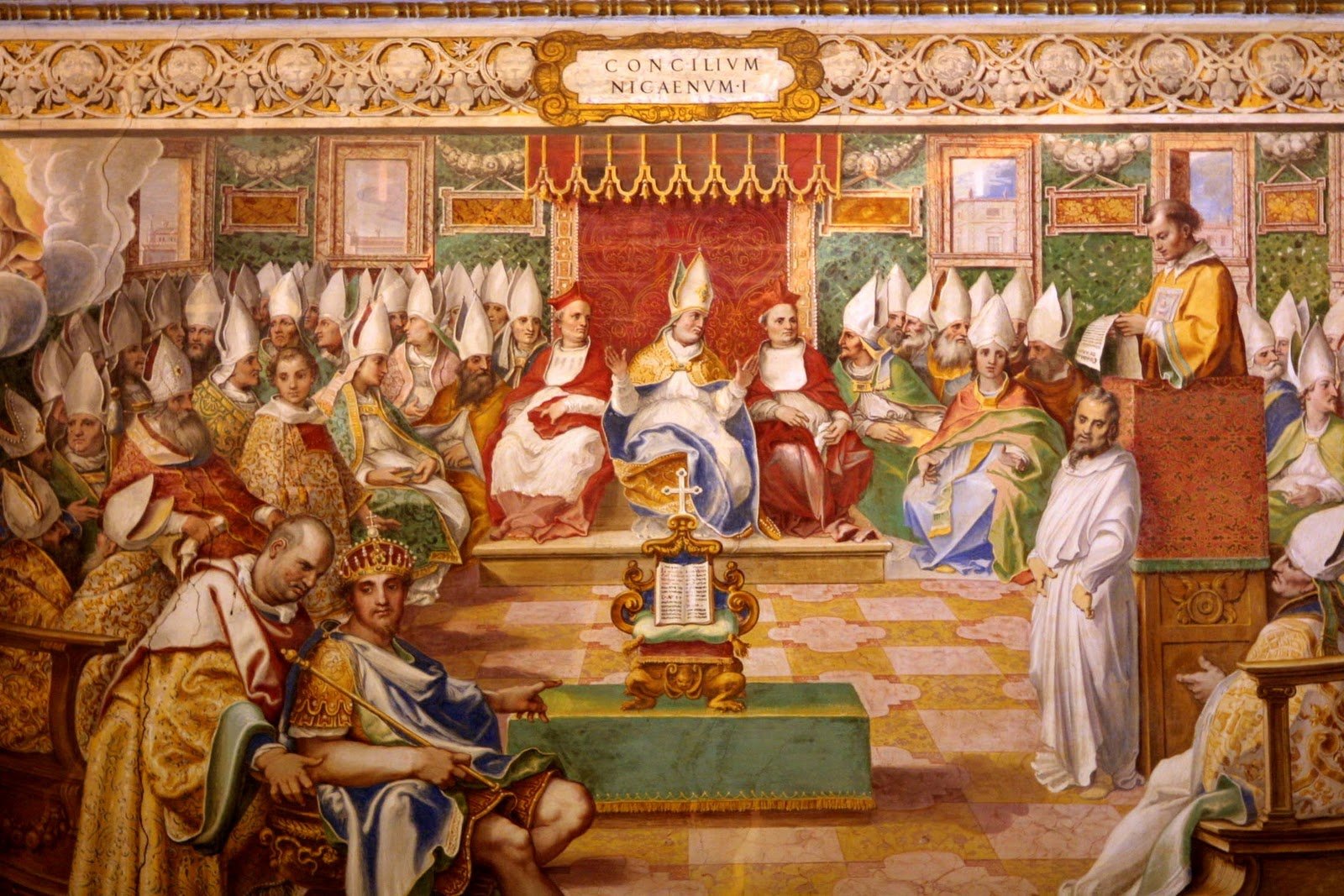
Theodoret, on painting the opening scene of the bishops, has one final stroke of the brush: “In short, the Council looked like an assembled army of martyrs.” He says this disabled, disformed, disfigured army walked into a room and would willingly face, face down if necessary, an Emperor. With maimed, mutilated, mangled bodies these wounded warriors were ready, willing, and able to offer their witness when the Emperor entered the room, stood before them and, sat down with them.
Constantine the Christian Layman
Enter Constantine. Constantine had come earlier to Nicaea, probably to make good on preparations. He returned to Nicomedia, Licinius’ former palace, to celebrate his victory over Licinius in September just past, and his execution a few months previous. Returning to Nicaea, two days from Nicomedia, he settles in the palace there. When he arrived, Constantine was inundated with parchments of complaints from the bishops who wanted him to set right their grievances for injustices back home. Now, for the first time, they thought an Emperor might care and act on their behalf.
The bishops were gathering and gathered in the nearby Great Hall of the Imperial Residence. The space is large and oblong. Pillars now stand in ruins for us to see. At the center of the Great Hall was a copy of the Gospels ––the closest physical representation to the presence of Christ they had. Constantine came without a bodyguard. His bodyguards were heathens, Germanic warriors, they were unwelcome. Later Emperors would use as bodyguards Vikings whose bored and random etchings are still visible on pews in great sanctuaries where Emperors worshipped from their balcony boxes.
At the long end of the Hall was a low seat waiting for the Emperor. He entered walking. The bishops stood and hushed. This was their first glimpse of the first Christian Emperor, the Conqueror, the Augustus. Contemporaries describe Constantine as handsome, muscular, long-haired, with penetrating eyes. He is robed to perfection ––an imperial diadem of pearls, a purple robe, scarlet shoes now wore only by popes. Adding to all the finery was the recognition of all he had done already for the Faith and Church. The bishops must have been in awe.
But, so too, no doubt was Constantine. He was in the midst of the largest gathering of leaders of the community he had recently professed himself an adherent. Theodoret begins his account of the spoken proceedings by saying the Emperor “like an affectionate son, addressed to the bishops as to fathers, laboring to bring about unanimity in the apostolic doctrines.”
Constantine walked the long central corridor of the Hall to its end and his provided seat – a low seat in the center, with the bishops before him on the left and the right. He asked their permission to sit. Nothing like this had ever happened. He was a layman––yes, the most powerful man in the world of his day and for the last generation ––yet they were the leaders. Together they sat down.
His stature and fineries contrast with their bent and broken bodies. This moment of meeting is the great reversal––Emperor and Bishops together, not persecuting and persecuted. History shows it is also the apex and beginning of the decline of the former––Roman Emperors over the generations will weaken and now are no more. History shows this is but one marker in the public advance of the Church––still advancing today.
We will forgive the bishops if they were still somewhat wary, though justifiably weary. The scars were recent and real. Sudden horrors had happened previously. How many, like Christ, had been warned by their disciples not to travel toward trouble? They hoped. Their faith was strong. They came, open to whatever and whoever would come. They fearlessly would fight for the Faith which thousands upon thousands had lived and died before them. That is the Faith in which millions upon millions since have lived and died.
We will forgive the bishops if they, in alternating contrast, imagined their future in terms more optimistic than history would warrant. There is a difference between pursuit and persecution of a king one year, and a request for help showing all due dignity by a king the next. A century later, Augustine, who admired Constantine, would find himself repeatedly warning his contemporaries with the mantra: “The Emperor may have become a Christian, but the Devil has not.”
The Apostolic Church
The Church is apostolic, so says the Nicene Creed. “Nicene Christianity” is a common short-hand for believing to be true to the Creed the Nicene bishops crafted––believing it to be the Faith as taught by the apostles, thus apostolic. Surely this is so. Nicene Christianity and being apostolic is also rightly a reference to the life of the church––what the apostles and Nicene bishops did––teach and preach the Gospel, sometimes at great cost. The Church is apostolic when it believes what and acts as the apostles did.
Grammatically, ‘continuing in the apostles’ teaching’ uses ‘teaching’ most commonly as gerund (a verb acting as a noun). That is, the ‘teaching’ is the content of the Faith, the truths expressed in Scripture by the apostles and now formulated as doctrine by the bishops. When we believe what the apostles taught, we continue in their teaching, we are, the church is, apostolic. ‘Teaching’ is also, perhaps less commonly acknowledged, a simple verb here. This is a reference to what the apostles did–– they taught, by travel and trial, by preaching and proclamation. They obeyed the Great Commission by proclaiming the Gospel.
The church that is apostolic holds true to the truth and, just as importantly, lives evangelically by spreading the Gospel. The church that goes out, making disciples by baptizing and teaching, is apostolic. The church that does not, is not. The Creed contains and thus continues doctrinal formulations first taught by the apostles. We memorize and recite, believe and teach these truths. And, as importantly, these Nicene bishops were apostolic for continuing what the apostles did as recorded by Luke in the church’s first history.
The Nicene bishops, Theodoret insists, were apostolic for both reasons. He begins with arguing for these bishops having lived apostolic lives by being on the apostolic mission; sometimes at great cost he emphasizes. They “bore the marks of the apostle in their bodies.” The following bulk of his account of the meeting at Nicaea, by recounting the details of the debate, will argue for the apostolic nature––the Biblical base––of their Christological formulations.
The bishops who state that the church is apostolic were themselves apostolic, continuing in the apostolic teaching, in both senses of the word. These bishops knew and lived the apostolic Faith. You can hear it in their creed. You can see it in their deeds. Because of this moment, and Theodoret’s report of it, we will henceforth recite and remember that the Church is apostolic.[2]
The history of the church as experienced by the faithful and reported by its historians will record many trials and tribulations yet to come. Some, indeed, are self-inflicted, as was so in needing to call this council to answer the internally generated distortions of the Faith. But this one moment will stand as a paradigm shifting change in the histories of the people of God and the world, church, and empire. The moment is worth celebrating, even now, seventeen hundred years later.
For further research and writing that would help guide us in knowing how much theology matters and how it matters, I suggest exploring not only the published articulation of the Faith but the faithfulness of the Westminster Divines and the Barmen Confessors, and other makers of creeds, confessions, and catechisms.
[1] Theodoret, “The Ecclesiastical History” in Nicene and Post Nicene Fathers, American Edition, 2nd series, III, trans. Blomfield Jackson (Peabody, MA: Hendrickson, 1994), 1–159. For further reading, see Bryan M. Litfin, The Nicene Creed: The Story of the Trinity: Controversy, Crisis, and the Creation of the Nicene Creed (Grand Rapids: Baker Books, 2025).
[2] I thank my friend Darrell Guder for teaching me to read the Nicene marks––one, holy, catholic, apostolic––“backwards.” My section on apostolicity leading to catholicity owes much to him. Darrell also convinced me, after much effort, that ‘to continue in apostolic teaching’ meant not only believing what the apostles taught, but doing what they did––going out, “being missional.”